
Address delivered 16/11/2026 at the Financial Institutions Remuneration Group Conference
Good afternoon
I acknowledge the Kombumerri people of the Yugambeh Language Region, the Traditional Custodians of the land on which we gather today and pay my respects to Elders past and present.
I acknowledge the enduring knowledge, leadership and contributions of First Nations peoples, as we reflect today on how we recognise and value people’s work.
Thank you for inviting me to join you and congratulations to FIRG on its 40th anniversary.
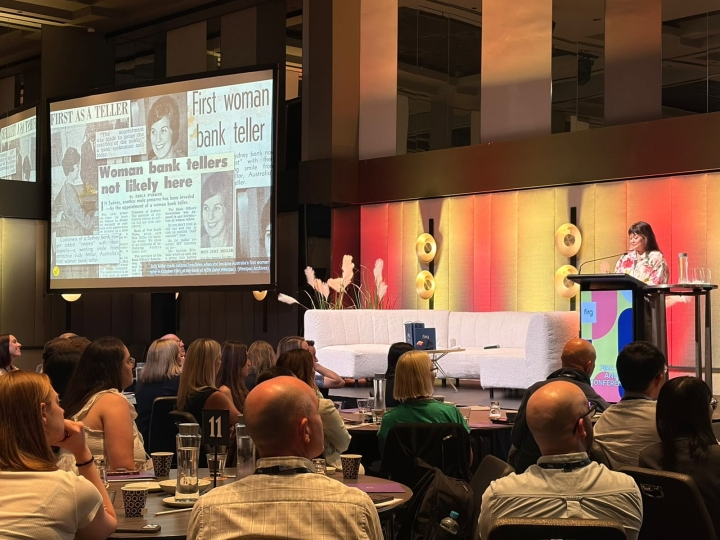
I want to begin with a story from Australian banking history. In October 1961, Judy Millar walked into the Bank of New South Wales branch at Wynyard in Sydney to take up a new position: she was becoming a bank teller.
That might not sound remarkable today. But in 1961, it was national news. Until then, women working in the bank had largely been confined to clerical roles behind the scenes. Judy had already worked for the bank for nine years. But her appointment as a teller was an experiment. The bank wanted to see how customers would react to a woman serving them.
Newspapers reported the appointment as another male preserve being invaded. It seems extraordinary now. But it tells us something important about workplaces. Sometimes the barriers to getting a job or a promotion have little to do with capability and much more to do with point in time views of what is normal.
The story reminds us how much has changed.
Today, women make up 53 per cent of Australia’s financial services workforce. Yet they hold only around 13 per cent of CEO positions.
We have made significant progress in opening the doors of the industry. But are we making the most of the talent that has walked through them?
This is the question I want to explore with you today.
It seems particularly fitting for me to be here, as FIRG celebrates its 40th anniversary. Because 1986 was also the year Australia passed the affirmative action legislation that established the Affirmative Action Agency that would eventually become the Workplace Gender Equality Agency. So, in a sense, we share a birthday.
FIRG has spent four decades helping financial institutions understand how to attract, retain and reward their employees. At WGEA, we look at many of the same questions, but through the lens of workplace gender equality.
And there is good reason for us to be interested in each other’s work. Because decisions about who gets hired, who gets promoted, who gets the best opportunities and who gets paid what are also the decisions that shape an organisation’s gender pay gap.
This is not just a conversation about fairness. It is about how businesses make the most of their people.
Women are in the industry, but not equally represented in the roles that pay or lead
Let’s start with the evidence:
Women now make up 53 per cent of the workforce.
9 in 10 employers have undertaken a gender pay gap analysis.
Around 97 per cent have formal policies or strategies supporting flexible work. And 91 per cent offer employer-funded paid parental leave.
These are significant achievements. They reflect years of investment, leadership and change.
But look beyond those policies and a more complicated picture emerges:
- Women are around 43 per cent of managers, 34 per cent of key management personnel and
- just 13 per cent of CEOs.
At board level, women hold around 31 per cent of directorships and 17 per cent of chair positions.
And despite the industry’s investment in gender equality, it continues to have one of Australia’s largest gender pay gaps – 21.4% (2nd to construction 23.8%).
So, we have made real progress in getting women into the industry. But we are not seeing that same progress at the top. For an industry that understands the importance of investing in talent, that is worth examining.
Women are entering the industry. The policies are largely in place. But women are not reaching the most senior and highly paid jobs at anything like the rate we might expect from their overall representation.
The data should concern us. Not because every organisation should have identical numbers of women and men in every job. But because it raises questions about who gets promoted, who receives the highest pay and bonuses, and how employers identify and develop their future leaders.
Before going further, I want to clarify something that is often misunderstood:
The gender pay gap is not the same thing as unequal pay for equal or comparable work. Equal pay has been a legal requirement in Australia since 1969.
Instead, the gender pay gap measures the difference between what women and men earn, on average, across a workplace or industry. It reflects many things:
The occupations people work in. The jobs they hold. Their working hours. Who gets promoted. Who has access to the highest-paid roles. And how organisations assess performance and set pay.
I think of the gender pay gaps as a useful analytical tool.
It tells us where to look.
The useful question is not just whether an organisation has a gender pay gap. It is what is happening inside that organisation to create it.
Australia is unusually well placed to investigate this because of the Workplace Gender Equality Act.
Each year, employers with 100 or more employees report workforce and workplace data to WGEA. This gives us information from around 10,000 organisations covering close to six million employees across the Australian economy.
We see patterns in pay, promotion, management, flexible work and parental leave. We can compare what happens across industries and between employers.
And here is something worth thinking about. By the time an organisation calculates its gender pay gap, most of the decisions that produce it have already been made.
Some were made this year. Others may have been made two or five years ago.
- When someone was given a major client portfolio.
- When someone was selected for a high-profile project.
- When someone returned from parental leave.
- And when a decision was made about who might be the best person for a promotion.
So, to get you thinking about what might be happening to cause a gender pay gap, let me ask you a few questions
If women make up 53% of the finance industry and we have all the right policies, why is there still such a big pay gap?
A. Who gets into senior and higher-paid roles
B. Career interruptions and caring responsibilities
C. How performance and remuneration are assessed
D. Workplace culture and expectations about work
My answer? All four. And the important thing is how they reinforce one another.
Who gets the senior job is shaped by who can works the hours expected, who has had career interruptions and who has been given the work that is seen and leads to promotion. So the gender pay gap is not simply the result of decisions made during the annual remuneration review. It is the cumulative result of decisions about jobs, promotions and pay made over an entire career.
I sometimes hear the argument that gender pay gaps are simply the result of individual choices.
Women choose different careers. They choose to work fewer hours. They choose to take time out of the workforce.
Of course, people make choices. And we should respect those choices.
But we should also ask how much choice people really have.
If taking time out to care for a child or an ageing parent makes promotion less likely, is that simply a personal choice?
If a highly capable employee cannot take a senior job because it has always required long and unpredictable hours and attending at afterhours client events. Is that a question of ambition? Or is it worth asking whether the job could be done differently?
Because if the highest-paid roles favour people with fewer responsibilities outside work, are we necessarily promoting the most capable people? Or the people best able to accommodate the hours and demands we have built into those jobs (often because they have a full-time partner at home taking care of the family and home responsibilities)?
These are important questions for an industry that pays such close attention to performance, investment and return. Because the gender pay gap data gives us a basis to examine not just how we reward people, but how we organise work to get the best performance and return on investment.
The missing middle: Where does the talent go?
One of the most revealing findings from WGEA’s data is what happens as women progress through their careers. For decades, we have focused on encouraging women into industries and occupations where they were underrepresented. That work remains important. But in financial services, women are already the majority of employees.
So we need to look beyond recruitment. Women are moving (43%) into management. Yet their representation falls as we move towards executive leadership- 34% of KMP, 13% of CEOs. And across the Australian workforce, we see concerning patterns of women leaving management roles.
The question is not simply how we get more women into the pipeline. It is why we are losing some of them along the way.
Our recent research with the Bankwest Curtin Economics Centre helps explain what is happening.
Using HILDA data, the researchers found that women continue to do more unpaid household work than their partners, even when both work full time.
And the research found a disconnect.
More than 90% of employers offer flexible start and finish time and 86% offer part-time work. But only 13% have designed management jobs to be done part-time.
So flexibility is widely available. Until you want to move into leadership. Men face expectations also. Taking extended parental leave or reducing their hours to do family care can often attract a career penalty for stepping away from the traditional path.
The result is that women are more likely to adjust their working hours and careers to accommodate care, while men are more likely to remain on the traditional path to senior leadership.
And there is a business cost.
Think about some on e who has spent 15 or 20 years building their career. Their employer has invested in their training, their expertise and their relationships with clients. They are good at what they do.
Then, their caring responsibilities change. They may need to work differently. They haven’t suddenly become less capable. They haven’t lost their experience. But if they are struggling to juggle a senior job with their family responsibilities, they may leave or decide not to pursue the next promotion.
That is a poor return on years of investment in talent.
This matters in an economy facing skills shortages, pressure to lift productivity and an ageing population. We cannot afford to treat the loss of experienced employees, or their exclusion from senior jobs, as simply an unavoidable feature of working life.
In financial services, building trust, responding to clients and managing complex relationships are fundamental to commercial success. There will always be periods when people need to work intensively to deliver important results.
But when we reward long hours and constant and visible availability, how confident are we that we’re rewarding the value people create, rather than simply the way they work?
Those things are not necessarily the same.
Consider two employees.
One has a major client-facing role. They attend industry events, build relationships, travel frequently and are highly visible to senior executives.
The other works behind the scenes, bringing deep technical expertise. They undertake complex analysis, manage risk, solve difficult problems and provide the advice on which major commercial decisions depend.
Both may be exceptional performers. Both may be essential to the organisation’s success.
But whose contribution is more visible? And does that visibility influence who gets recognised, promoted and rewarded?
Of course, different jobs have different market values, responsibilities and commercial outcomes. I’m not suggesting otherwise.
But there is a difference between recognising commercial value and simply recognising the work that is easiest to see.
And this becomes particularly important when employees don’t have equal access to the most visible assignments.
Who gets to meet major clients? Who is given the most valuable portfolios? Who gets the projects that lead to promotion? Who is sponsored by senior executives? And who is doing the technical, analytical and operational work that enables others to succeed?
These are not questions about whether people deserve their pay. They are questions about whether organisations recognise and reward all the work on which their success depends.
Let me bring this closer to your professional expertise. In financial services, discretionary remuneration is an important part of how organisations attract, motivate and reward employees.
And rightly so.
Bonuses and incentives can support performance, align individual and business objectives, and recognise exceptional results. But they can also reveal patterns worth investigating.
The data in our briefing shows that men’s average discretionary payments in financial services are around 58 per cent higher than women’s. That is a substantial difference.
We need to interpret this data carefully. The gap may reflect the concentration of women and men in different jobs, seniority levels and bonus arrangements.
But it is a difference worth investigating.
Who gets into the jobs where the largest bonuses are available? Who manages the most valuable client portfolios? Who receives the assignments that generate strongest commercial results?
I would encourage you to look beyond whether remuneration policies are applied consistently. Ask whether employees have comparable chances to build the track records those policies reward. Because a remuneration system can be technically sound, consistently administered and still reproduce inequalities embedded elsewhere in the organisation.
This is where your expertise matters. You can examine patterns across jobs, business units and seniority levels that individual managers may not see. Not simply who received what. But why.
And whether those patterns reflect genuine differences in performance and responsibility, or differences in who has been given the chance to demonstrate them.
The flexibility paradox
Financial services is an interesting case study in the difference between policy and practice. Almost all employers in the industry have access to formal flexible work arrangements.
That is a significant achievement for the industry. But still, women are around six times more likely than men to work part-time. 18% of women in financial services work part-time, compared with just three per cent of men.
So we need to ask what flexibility means in practice. Does it mean employees can work differently and still get promoted? Or does it mean they can work differently, provided they accept a narrower range of jobs?
There is an important difference between offering flexible work and making ‘career opportunity’ jobs genuinely accessible to people who work flexibly.
Good flexibility enables people to contribute, develop and progress while managing responsibilities outside work. Bad flexibility can leave people in lower-paid jobs, with fewer development assignments and limited prospects of promotion.
And sometimes the difference is not in the policy. It is in the assumptions managers make.
Can someone lead a major team part-time?
Can an executive work a compressed week?
Can two people share a senior management job?
Can someone take extended parental leave and remain a serious candidate for promotion?
I am not suggesting every job can be done in exactly the same way. But I do think we should be more ambitious about what is possible.
If financial institutions can redesign complex products, transform customer experiences and use technology to manage extraordinary volumes of information, surely they can apply some of that ingenuity to how jobs are structured.
And that brings me to my next audience poll question.
Which of these ideas about work is hardest to change?
A. You can’t lead a team part-time
B. Taking time out means putting your career on hold
C. Long hours show you are committed
D. The best person for promotion is the one with the longest and strongest track record
I suspect most of us have heard every one of these statements. Perhaps we have even said them ourselves. And that’s what makes them so difficult to challenge.
They sound reasonable, and some reflect genuine business demands.
But how often do we think about what a job genuinely requires from what we have simply come to expect or are familiar with? Does leading a team really require being there five days a week? Do long hours demonstrate better performance or simply greater availability? And when we talk about choosing the person with the strongest track record, have we considered how that track record was built?
I am not suggesting we lower expectations or compromise performance.
But if we only promote people who have followed the traditional path, we may overlook capable employees who have taken a different one. What I am suggesting is that we get much better at questioning whether the way we have always organised work is actually the best way to get results.
Generations, care and the future workforce
I want to bring another dimension int this discussion. We hear a great deal about different generations in the workforce: Baby Boomers, Gen X, Millennials and Gen Z.
And there is no shortage of commentary about their different attitudes to work. I am cautious about these generalisations. But I think there is something more useful for employers to consider.
Take Baby Boomers. Those still working bring decades of experience, expertise and institutional knowledge. Some want to keep working, but perhaps not in the same way or at the same intensity. Are we making it easy enough for them to do that?
Then there’s Gen X. Many are now the most experienced people in our organisations, holding senior management and executive positions. But they are also increasingly likely to be caring for ageing parents, supporting adult children or managing other family responsibilities. And those responsibilities can be unpredictable.
We tend to talk about caring as though it primarily affects parents with young children. But care doesn’t end when children start school. And it doesn’t begin or end with parenthood.
For many people, the most demanding caring responsibilities arrive at precisely the point in their careers when they are expected to take on the greatest leadership responsibilities.
Then consider Millennials. Many are now in their thirties and early forties. They are moving into the middle and senior management jobs that will shape the future of Australian business. They are also navigating housing costs, raising families and combining paid work with unpaid care.
And then there is Gen Z. The oldest are approaching 30 and some are already moving into their first management roles. They are entering our workforce at a time of extraordinary technological change and seeing established assumptions about careers, skills and job security challenged by artificial intelligence.
These are not peripheral issues. They shape the time, energy and experience people can bring to work and whether businesses can attract, retain and make full use of their talent.
And here is why I think this matters.
Millenials are moving through, and Gen Z is approaching, the very stages of career progression where WGEA’s data shows women losing ground in the leadership pipeline. We are seeing concerning pattens of women leaving management roles, with representation falling as they move towards more senior positions.
So we are not just talking about the challenges facing today’s workforce. We are talking about the trends that could determine who will lead our organisations for the next 20 or 30 years. If we don’t pay attention to what happens to employees at these critical career stages, we risk repeating the same patterns for another generation.
And this is not just about younger employees. Older workers want flexibility. Men want to be involved parents. People with disabilities want jobs designed around what they can do, rather than assumptions about what they can’t. Carers want to continue working and progressing without having to choose between their jobs and the people who depend on them.
The future workforce won’t fit neatly into the working arrangements of the past. And employers who recognise that early will have an advantage.
I also want to emphasise that this isn’t simply a conversation about women. Gender equality requires us to think differently about the expectations we place on men.
Financial services has made substantial progress in providing employer-funded parental leave. The industry has some of the most extensive parental leave arrangements in Australia.
But having leave available doesn’t mean men and women use it equally. Men account for a much smaller share of employees taking primary carer leave than their representation in the workforce.
And we should ask why. What happens when a man tells his manager he wants to take several months of parental leave? Is that treated as a normal part of his career? Or as an unusual interruption? Do male executives take substantial parental leave? Do they work flexibly? And do the employees who report to them feel they can make the same choices?
When men are discouraged from taking on caring responsibilities, women often carry more of that responsibility by default. And that affects women’s working hours, promotions and earnings.
We cannot expand women’s choices without also expanding men’s choices. Rather than treating care as an individual accommodation, we should recognise it as a normal part of working life.
For women and men. Across generations. And at every level of seniority.
Artificial intelligence: A chance to redesign jobs
Your conference is also exploring artificial intelligence.
And I think there is an important connection with today’s discussion. We are entering a period of profound change in how work is organised.
AI is already changing how information is processed, how decisions are supported and how tasks are performed. Some jobs will change significantly. Some tasks will disappear. New jobs and skills will emerge.
But this is what interests me: for decades we have been asking how people can adapt to the jobs we have designed.
But the important question isn’t simply what technology can do.
For example, if technology reduces the administrative burden of a senior management job, could that make part-time leadership more viable?
If routine tasks are automated, could we redesign jobs to place greater value on judgement, relationships and complex problem-solving?
Could we reduce some of the long hours and constant availability that we have come to accept as essential to senior jobs?
These aren’t guaranteed outcomes.
Technology doesn’t automatically produce more equitable workplaces. In fact, if we are not careful, it can reinforce existing inequalities.
Women hold a substantial majority of clerical and administrative jobs in financial services, many of which are exposed to AI-driven change. So employers need to think carefully about what happens to the people doing those jobs.
Will they be given opportunities to learn new skills and move into different roles? Or will we simply recruit people with new capabilities while losing experienced employees who already understand the business?
And as AI changes the work done in professional and management roles, will we rethink how those jobs are structured? Could some be done more flexibly? Could we place greater value on judgement, expertise and results, rather than hours worked or physical presence?
AI will change how work gets done. But the bigger opportunity is to use it to redesign jobs, retain valuable skills and open up career pathways that traditional ways of working have limited.
So as technology changes how work is done, it also gives us an opportunity to reconsider how we assess performance and recognise talent.
Which brings me to my final question for you.
When it comes to getting ahead, what matters most in financial services?
A. The expertise and value you bring
B. The client relationships you build
C. Being there when important connections are made
D. Having your work recognised and rewarded — client-facing or behind the scenes
I think this is a particularly interesting question for this audience. Because all four matter.
Expertise matters. Client relationships matter. Being present when important relationships are built matters. And recognising and rewarding valuable work certainly matters.
But are we equally good at recognising different kinds of contribution? And do we sometimes reward the work we can see more than the work we can’t?
There’s nothing inherently wrong with recognising employees who build strong client relationships. Those relationships are commercially valuable. And there’s nothing wrong with recognising people who make themselves available when clients or colleagues need them.
But we should ask whether everyone has the same chance to build those relationships. And whether we’re adequately rewarding the employees whose technical, analytical and operational work makes those commercial results possible.
Because there is a difference between creating value and being visible when that value is recognised.
And this is where remuneration professionals can make a difference.
You have the data. You understand how performance assessments, salary reviews and bonus structures operate.
And you are well placed to test whether those systems recognise the full range of work that contributes to commercial success. Not just whether the remuneration framework is technically sound. But whether it helps the organisation identify, retain and reward its most valuable employees.
Whether we are redesigning jobs through AI or rethinking how we recognise or reward performance, the question is the same: what are we going to do differently?
Moving from measurement to management
This brings me to the next phase of Australia’s workplace gender equality reforms: moving from identifying the gaps to taking action to close them.
From this year, larger employers are required under legislation to select gender equality targets informed by their own data.
The value of targets lies in the decisions they prompt.
If an organisation sets a target to increase women’s representation in senior management, what will it change about recruitment, promotion, succession planning or job design?
If it wants to reduce its gender pay gap, what will it change about salary reviews, bonuses and access to the highest-paid jobs?
And how will it know whether those changes are working?
This is where remuneration and People and Culture professionals have an important role. You are not simply custodians of data.
You help design the systems through which organisations assess performance, set pay and promote employees. You can identify patterns that individual managers may miss. And you can help ensure that commitments made by boards and executives translate into measurable results.
In two days, WGEA will release its 2026 Gender Equality Scorecard.
It will provide another opportunity to examine progress across Australian workplaces and the challenges that remain.
I encourage you to use that data. Not simply to see where your organisation ranks.
But to investigate what the comparisons reveal. Which employers a re retaining more women in management?
Which are reducing their pay gaps? And what are they doing differently?
Because the purpose of WGEA collecting this information isn’t simply to produce another report. It is to help employers make better decisions.
Closing — The next forty years
I want to finish where I began.
When Judy Millar became a bank teller in 1961, the question was whether a woman could do a job traditionally reserved for men. They clearly could.
We have come a long way from questioning whether women should be bank tellers.
But there is a risk that the progress we have made becomes the limit of our ambition, rather than the starting point for what comes next.
We have better policies, better data and greater transparency. But the challenge is not just getting women through the door. It is ensuring they stay, progress and lead.
And for an industry that invests so much in talent, that matters.
We often talk about what it will cost to change the way we work. But what does it cost us not to change?
What does it cost when experienced employees leave and we have to recruit and train their replacements? When positions remain vacant, teams carry additional workloads and valuable expertise and client relationships are lost?
These are real business costs; in time, money, productivity and lost opportunity. And they are costs we cannot afford to overlook. And if I can leave you a question to ponder, what if some of the people we are paying the most are not necessarily creating the most value – but the ones who are better at playing a workplace game that was written for people like them?
As FIRG celebrates forty years, I hope you will find ways to challenge established thinking about how we recognise, develop and reward talent.
Because the opportunity in front of us is not just to build fairer workplaces. It is to make better use of our people, and to build better performing businesses.
Thank you.