August 19 is the national Equal Pay Day 2025. The day marks the end of the 50 additional days into the new financial year that women in Australia need to work to earn the same pay, on average, as men.
This year’s theme is “How does your employer measure up? When’s your Equal Pay Day?”
This year, you can work out the individual Equal Pay Day for your workplace.
That is, how many extra days women must work from the end of the financial to earn the same, on average, as men. And if you work in one of the 8% of workplaces that has a gender pay gap in favour of women, you can see how many extra days men need to work, to earn the same amount, on average as women.
VIDEO: Mary Wooldridge explains why Equal Pay Day is important
WGEA CEO Mary Wooldridge says Equal Pay Day is an important measure of inequality in our workforce.
“This is an important campaign to understand how inequality sits in a workplace and start a conversation about how we can address it.”
WGEA's Equal Pay Day Calculator

Ready to find the Equal Pay Day for your workplace?
It's simple to use our nifty Equal Pay Day calculator.
- Jump onto WGEA's Data Explorer and look up your employer's gender pay gap by typing in your employer's name or ABN. (While you are there, there's lots of other interesting gender equality information about your workplace as well.)
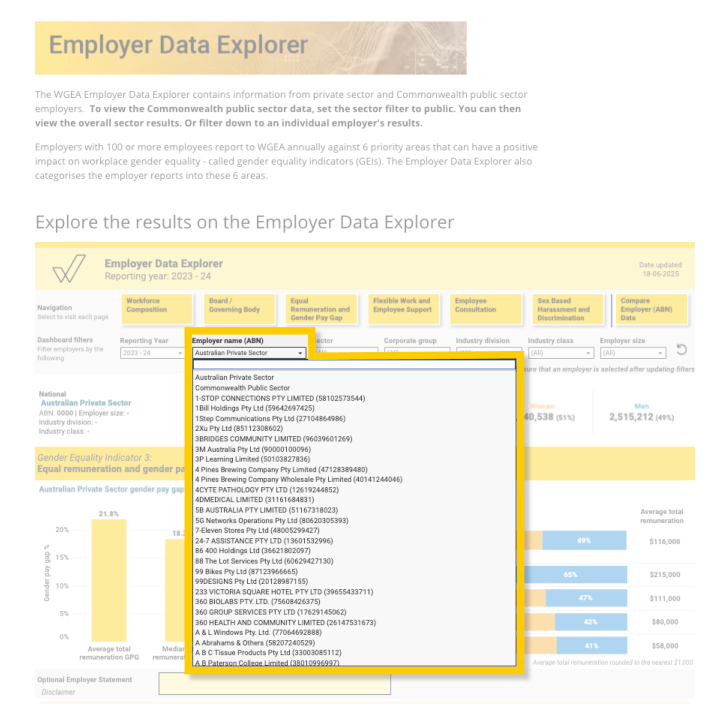
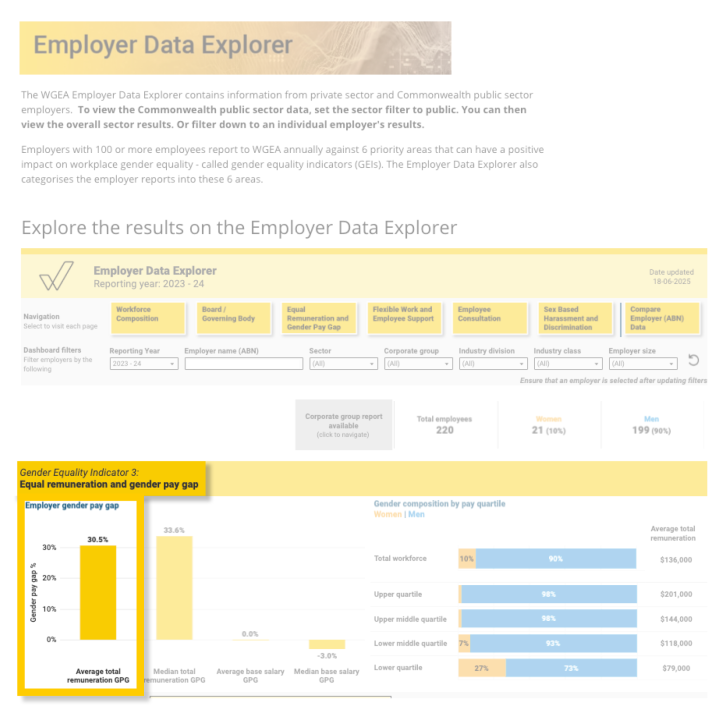
2. Take the average total remuneration gender pay gap figure and feed it into WGEA's Equal Pay Day Calculator to compute the date that women in your workplace need to work in order to earn the same average pay as the men. You'll find it if you click on the third yellow tile near the top of the page - Equal Remuneration and Gender Pay Gap.
If you have a negative gender pay gap, don't forget the minus symbol in front, and the calculator will tell you how many extra days the men need to work to earn the same average pay as women. (Read below on why we use this number to work out your workplace's Equal Pay Day.)
Dig into the data. Find the causes. Start a conversation. And help to #endthegenderpaygap
How is the national Equal Pay Day calculated?
WGEA uses the Australian Bureau of Statistics (ABS) average weekly earnings trend data to calculate the number of days after the end of financial year that women have to work to be paid the same as the average man. This is our national Equal Pay Day.
In February, the ABS reported its average weekly earnings for men and women from November 2024.
Men working full time earned $2072.70, while women earned $1,826.40 per week on average. That’s a difference $246.30 every week and $12,807.60 every year.
At the average rate of pay for women, this is the equivalent of over seven weeks additional work (50 days).
The Equal Pay Day campaign will run for 50 days, until Equal Pay Day on 19th August.
It’s important to note the ABS figures are base salary and full-time employees only. They do not include bonuses, superannuation or overtime – which men are more likely to earn – or the salaries of Australians working part-time.
WGEA recommends using your workplace’s average total remuneration gender pay gap in the Equal Pay Day Calculator to calculate individual workplace Equal Pay Days. Your employer total remuneration gender pay gap includes base salary and additional payments, and so is the best way to calculate your workplace’s equal pay day.
WGEA research has identified three main contributors to Australia’s gender pay gap: gender discrimination; care, family responsibilities and workforce participation; and gender segregation by job type and industry.
What is your employer doing to address the issues that drive your workplace’s gender pay gap?
VIDEO: Mary Wooldridge says Equal Pay Day is an opportunity to stop and reflect on inequalities in the workplace.
For executives and leaders in workplaces, it's important to understand Equal Pay Day and the gender pay gap in your workplace, and take steps to address it.
Conducting a comprehensive gender pay gap analysis is the critical first step to identifying the drivers of inequality. If you need a little help, you can attend a WGEA Gender Pay Gap Analysis Masterclass or read our guide: Gender Pay Gap Analysis Guide: Find the cause of your gender pay gap.
WGEA is also encouraging employees to ask whether their employer has done a gender pay gap analysis and what strategies they have to improve gender equality. Do they have a consultation group to find out what employees think about equality in the workplace? You can find information to support your conversation on WGEA's Data Explorer, which contains details about each employer's gender equality performance, policies and strategies.
VIDEO: Mary Wooldridge has some advice for employees on how to start a conversation in their workplace.
VIDEO: How employers can mark Equal Pay Day in 2025.
Equal Pay Day, an internationally-used milestone doesn't actually use equal pay as the measure. Equal pay has been the law in Australia for 50 years.
Equal Pay Day is determined by the gender pay gap, which incorporates both composition and pay, when measuring the differentials in the workplace, on average, between what men and women earn.