The WGEA Gender Equality Scorecard provides an annual update on the state of workplace gender equality in Australia.
The information and data included in 2024-25 Scorecard is based on Gender Equality Reports from 8,239 employers, who reported to WGEA by 31 August 2025.
It offers an insight into the workplaces of more than 5 million employees across 19 industries in Australia.
Download the full report
The gender pay gap quick facts
The national picture
The average total remuneration gender pay gap is 21.1%.
For every dollar a man makes, a woman earns 79 cents.
Over the course of a year, this adds up to a difference of $28,356.
The size of the gap has slowly decreased since WGEA reporting began in 2013-14.
Since 2023-24, the WGEA gender pay gap has included CEO, Head of Business and Casual Manager remuneration.
State by state
Every state and territory reduced its gender pay gap.
The Northern Territory experienced the highest reduction at 2.5pp, followed by Tasmania (1.9pp), the Australian Capital Territory (1.5pp), and South Australia (1.3pp).
Queensland and Western Australia both narrowed their gender pay gap by 0.7pp, New South Wales by 0.6pp and Victoria, 0.5pp.
The size of the gender pay gap in each state or territory is often influenced by the make-up of industries present.
In Western Australia, which has the largest gender pay gap, men are concentrated in Mining, which is generally a highly-paid industry, while women are concentrated in Health Care and Social Assistance, which has a mid-range average total remuneration.
Why the gender pay gap narrowed
Over the past 12 months, the average base salary for women increased by $3,419 (4%), compared with a smaller increase for men of $2,895 (2.8%). This narrowed the average base salary gender pay gap by 1pp.
The median total remuneration gender pay gap reduced by 1.9pp over the year, building to a 3.7pp decrease since 2020-21.
The median decreased more than the average due to uneven wage growth and gender pay gap reductions between income levels.
Wages grew faster in the lowest (4.3%) and lower-middle (4.5%) quartiles, than the highest quartile (3%).
As the median reflects the middle of the distribution, it captures these improvements. The average is strongly influenced by the top end, when men continue to dominate and progress was slower.
There was a 1% increase in women in the highest pay quartile, and a corresponding decrease in the lowest earning quartile.
CEO gender pay gap
Women managers earned 22.8% less than men mangers. The manager gender pay gap increases with the level of seniority. Women CEOS earn $83,493 on average less than men in base salary every year.
When superannuation, bonuses, overtime and additional payments are included, this difference increases to $185,335. This results in an average total remuneration gender pay gap of 26.2%, an increase of 1.2pp in the past 12 months.
Progress
Employers are making progress to reduce the gender pay gap in their workplaces.
55% of employers reduced their gender pay gap, and more have a gender pay gap in the target range of -5 to +5%.
Importantly, after significant increases last year, the number of employers conducting a gender pay gap analysis and taking action on the findings has remained stable.
This indicates these critical first steps towards closing the gender pay gap are increasingly embedded and becoming business-as-usual for many employers.
More employers are now consulting their employees on issues of gender equality and have a formal policy for this process.
Progress is occurring in other areas that shape our workplaces and lives.
Men account for a growing proportion of primary carer's parental leave taken and more employers offer universal paid parental leave.
Slightly more women are Board members, and more employers are incorporating expectations for safety and respect into their recruitment and performance management processes following the introduction of positive duty.
These positive signs of progress sit alongside areas where more work needs to be done to ensure workplaces are fair, equal and safe.
Opportunities
This year’s WGEA Scorecards has identified 3 key areas for employers to focus on to accelerate gender equality.
Ensure safety – ensure the workplace is safe from abuse and discrimination
Improve gender balance – having a balance of women and men at all levels in the workplace
Dismantle stereotypes – breaking down stereotypes related to work, leadership and caring.
Ensure safety
Almost every employer (99.2%) has a policy or strategy to prevent sexual harassment. Of the 68 employers who did not have a policy, 61% indicated it was under development.
More CEOs and workplace leaders are communicating their expectations of respectful behaviour to employees and articulating standards in their organisation’s recruitment and performance management processes.
Employers now have a legal requirement to take proactive and meaningful steps to prevent sexual harassment in the workplace.
The involvement of the Board
Just 60% of employers had their policies to prevent sexual harassment and discrimination reviewed by their Board, and 59% of governing bodies communicate their expectations on safety and respectful and inclusive workplace conduct.
And 76% of employers report information on sexual harassment to the Board. But fewer than 15% of employers report their performance against the 7 standards on meeting the positive duty requirements to the CEO and the Board.
Board engagement and accountability can set the tone for organisations and and signals that gender equality is a strategic business priority.
Boards should ask CEOs for a higher level of engagement in these areas to mitigate the risk and do everything possible to have a workplace free of sexual harassment.
Board gender balance
Gender balance on the governing body is another opportunity to embed gender equality in organisational culture.
While there has been some improvement on gender-balanced Boards, men are still twice as likely to be governing body members than women.
This is despite research linking increased women's representation on Boards with improved company performance, profitability and productivity.
Although the proportion of women Chairs has increased, the Chair of a governing body is almost 4 times more likely to be a man.
Larger employers are the most likely to have achieved a gender-balanced governing body, and they are the most likely to set targets to achieve or maintain this goal. Only 1 in 10 employers set targets to increase the representation of women on Boards. Few employers with 100-250 employees – the group most likely to have men-dominated Boards – set targets to improve governing body gender composition.
The number of gender-balanced governing bodies has improved and the number of Boards with no women has reduced. Most governing bodies are men-dominated.
Women-dominated industries are the most likely to have gender-balanced Boards (more than 2.6 times as likely than men-dominated industries). Boards in men-dominated industries are the most likely to be men-dominated or have no women at all.
In the previous 12 months, Accommodation and Food Services has shown positive progress towards gender-balanced Boards (+6pp gender-balanced Boards, -6pp men-dominated Boards). Construction has reduced the number of governing bodies with no women by 3pp. But more than half of all Boards in this industry still have no women.
In the last 12 months, the proportion of employers with a formal policy to support gender-balance on the Board has increased 1pp to 44%. More employers have a policy inclusion for succession planning and most have an inclusion or selection of governing body members.
21% of employers are setting targets to increase or maintain women’s representation on the Board, but the overall proportion using this effective lever remains low.
Improving gender balance
While progress to reduce segregation across industries and occupations has occurred since WGEA reporting began in 2013-14, it appears to have stalled in recent years.
Imbalanced gender composition can occur across industries, across occupations or across levels of the workplace hierarchy.
It the single biggest driver of the national gender pay gap.
Desegregating Australia’s industries and occupations is a necessary step on the path towards fairer and more gender equal workplaces.
Attracting women and men into new industries and occupations
The proportion of women and men in the private sector workforce is roughly equal. Women make up 51% of the workforce, and men make up 49%.
Industrial gender segregation has grown for the past 2 years.
More than half the workforce is employed in an industry dominated by one gender.
Percentage of employees by industry gender composition
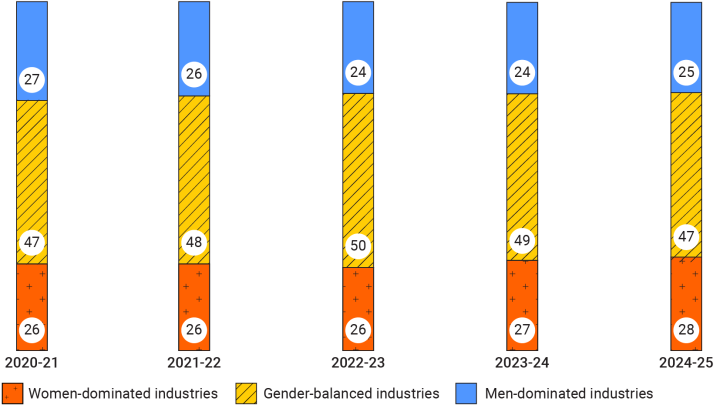
More than half of the women in the workforce are employed in 3 industries – Health Care and Social Assistance, Retail Trade and Education and Training.
While more men work across a broader range of industries, they are often adhering to traditional and gendered career pathways.
The number of gender-balanced industries fell in 2024-25; with fewer women working in Rental, Hiring and Real Estate Services it became a men-dominated industry.
The differences between women and men, in terms of the industries they work in and the average remuneration for those industries, is a key driver of the gender pay gap.
3 of the 5 most highly-remunerated industries are men-dominated: Mining, Electricity, Gas, Water and Waste Services, and Construction.
More than 700,000 women – more than a quarter of all women in the workforce - work in Health Care and Social Assistance.
Gender segregation in workplaces
An employee’s experience at work can be shaped by the gender composition of their workplace, regardless of their industry.
While almost half of employees work in a gender-balanced industry, only about 1 in 3 work in a gender-balanced workplace.
Gender composition of workplaces
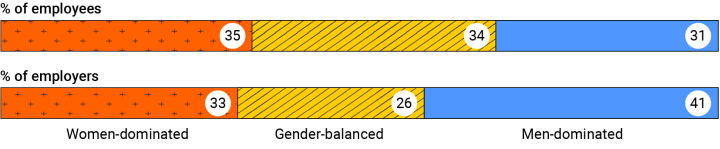
Progress to improve on segregation across industries and occupations has stalled in recent years.
From the earliest entry points into the workforce, women and men are following gender segregated career pathways.
Formal graduate and apprentice programs introduce new talent in a structured and supported way. The gender composition of these roles offer insights into the first levels of the talent pipeline.
In 2024-25, 53% of graduates and 20% of apprentices were women.
Women entering the workforce through formal graduate and apprentice programs are more likely to work in typically lower paid occupations such as Clerical and Administrative Service workers and Community Service workers.
Men are more likely to obtain formal graduate or apprentice program employment as Machinery Operators and Drivers, Technicians and Trades Workers and Labourers.
The non-manager workforce is gender-balanced, 53% of non-managers are women and 47% are men. However, gender segregation is evident in the types of non-manager roles and is largely unchanged from last year.
Gender composition of non-manager occupations

There’s an opportunity for employers to focus on recruitment and remuneration processes to deepen and diversify talent pools and improve the balance of women and men working in roles that might traditionally be women or men-dominated.
Breaking down gender segregation across industries and occupations is essential to closing the gender pay gap, improving economic security for women and unlocking the full potential of Australia’s workforce.
Achieving gender balance in management and leadership
Limited access to manager roles has been cited as a key driver of the gender pay gap.
43% of managers are women, an increase of 1pp year-on-year. But as the level of seniority increases, the proportion of women decreases.
There’s been an increase in women’s representation across all manager categories, but progress is slow to stagnant in some areas. The proportion of women CEOs remains at 22%.
Gender composition of manager roles
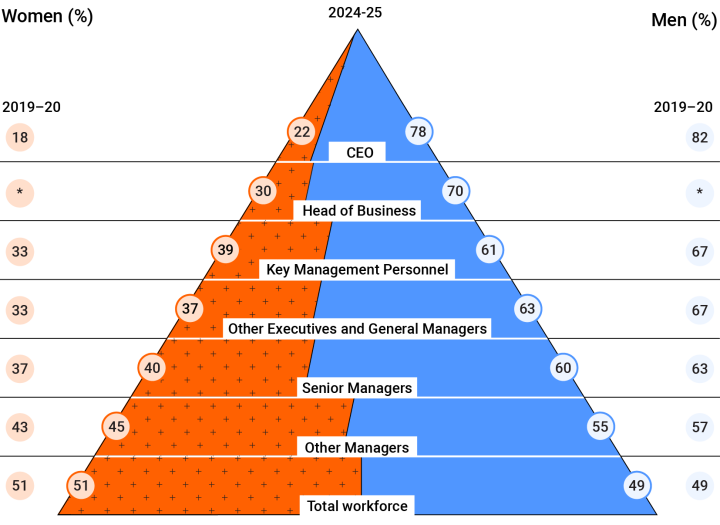
Information, Media and Telecommunications has achieved gender-balance in manager roles, one of 8 industries, out of 19, to do so.
The only industry to have gender balance of CEO roles is Health Care and Social Assistance, which is 78% women.
Much of the progress in women’s representation in management came from internal appointments and promotions.
There’s an opportunity for employers to increase the proportion of women being appointed externally to manager roles by reviewing their recruitment processes.
Research shows that screening for competency rather than tenure, randomising the order in which recruiters view applications and removing irrelevant information can de-bias the recruitment process and improve the rate of women hired. Employers using AI tools for recruitment should also review and address any bias built into these systems.
While more women are taking on manager roles, they are also resigning from them at disproportionate rates.
Gender equality reflection in exit interviews
Exit interviews are a critical moment to gain important insights from outgoing employees. However, only 63% of employers who consult with employees currently use them to ask about gender equality.
Asking about gender equality, safety and workplace culture can help employers to identify cultural or systemic issues that might be driving turnover.
Systematically capturing this feedback and analysing it can help governing bodies and executives identify patterns, address risks and strengthen retention strategies.
Dismantling stereotypes
Gender stereotypes continue to shape how employees are perceived and treated, influencing the opportunities and access to benefits they experience throughout their careers.
Increasing the availability of flexible working arrangements, parental leave and other support is important to enable equal workforce participation and equal caring responsibilities.
One persistent stereotype relates to paid and unpaid work, with women linked with caring and men with paid working. These are often reinforced by gendered assumptions and biases embedded in workplace policy and processes, which require sustained effort to dismantle.
Encouraging men to take parental leave
There are signs of progress. More men are taking primary carer’s leave than ever before, accounting for 20% of the 147,102 employees who took parental leave in 2024-25.
This 3pp increase builds on a further 3pp increase the previous year.
The increase was most noticeable in gender-balanced and men-dominated industries, with the biggest rise in Construction, followed by Rental, Hiring and Real Estate Services, Manufacturing and Financial and Insurance Services.
Removing carer labels
Parental leave is a key factor in attracting and retaining talent. Where employers offer paid parental leave equally to women and men, they signal a commitment to fairness and equality.
The proportion of employers offering paid parental leave, in addition to the government scheme, fell 1pp overall in 2024-25.
Most employers who offer paid parental leave still label parents as ‘primary’ or ‘secondary’ carers. The proportion of employers who offer universally-available parental leave – available to women and men equally - has increased slightly.
The percentage of employers who offer primary carer’s leave to women only is unchanged at 4%.
The larger an employer, the more likely they are to offer paid parental leave.
While the biggest increases in men’s uptake of parental leave occurred in men-dominated industries, employers in these industries were the least likely to offer employer-funded paid parental leave.
Women-dominated industries are more likely to offer employer-funded paid parental leave.
Proportion of employers offering employer-funded paid parental leave

Access part-time and job share opportunities
Another way to support employees to invest in their caring responsibilities is to provide greater access to part-time manager roles.
Part-time employees overall are 2.7 times more likely to be women, than men.
Employment status by gender

Women consistently work part-time at higher rates than men in every industry.
Offering more part-time manager roles is one way employers can improve their workforce composition.
Research also shows men would prefer to work part-time, but often do not have the option to do so.
In 2024-25, 92% of managers worked full-time. Just 7% of managers work part-time, and 1% casually. This is unchanged from the previous year.
This appears related to the ‘ideal worker’ stereotype, that senior roles require people to work long hours and be constantly available.
There are promising signs of progress with more employers including part-time manager roles in their flexible working arrangements policy items, but there are opportunities to do more work on uptake, particularly for men.
Flexible working arrangements such as hybrid of compressed working are also effective ways to support working carers and reiterate to employees that balancing work with outside work responsibilities isn’t incompatible with career development.
There’s also opportunity to improve uptake of flexible working arrangements among men.
Expanding access to part-time and flexible roles in leadership is a strategic lever for gender equality which can help to dismantle stereotypes, retain talent and support share care responsibilities.
Explore the data
The Scorecard is based on data from 8,239 employers covering the workplaces of more than 5 million employees.
Explore the data and information received from employers on a national basis, by industry or by individual employer in WGEA's Data Explorer.
Download past Gender Equality Scorecards
2023-24 Gender Equality Scorecard
2022-23 Gender Equality Scorecard
2021-22 Gender Equality Scorecard
2020-2021 Gender Equality Scorecard
2019-2020 Gender Equality Scorecard
2018-2019 Gender Equality Scorecard
2017-2018 Gender Equality Scorecard
2016-2017 Gender Equality Scorecard
2015-2016 Gender Equality Scorecard
2014-2015 Gender Equality Scorecard
Keep the conversation going
Compare your results to other employers and industries with the WGEA Data Explorer.
Gender equality is good for business. Find out how you can take action in your business starting today.
These employers lead the way on workplace gender equality in Australia. Find out why.