WGEA’s release of aggregate results from Commonwealth public sector reporting shows the sector has made significant progress in many areas critical to achieving gender equality at work.
The sector has achieved gender-balance (40:40:20) across all remuneration quartiles, on board membership including Chair roles and in almost all manager categories. 2/5 employers have a gender pay gap in the target range. Those who haven’t generally have lower gaps than the private sector. Nearly every employer offers paid parental leave in addition to the government scheme and men now account for 19% of all primary carer’s parental leave taken – matching the private sector after years of lagging behind.
129 Commonwealth public sector employers, employing more than 282,000 people, reported gender equality information to WGEA for the 2024 calendar year. WGEA published individual employer gender pay gaps and other information in March 2026, but today we are releasing the aggregate results. Information for employers and the public sector is now available on the WGEA Employer Data Explorer.
The employers lodged their reports in September – October 2025. From this year, Commonwealth public sector employers will submit their gender equality reports at the same time as private sector employers (April-May) and WGEA will release the public sector data with the private sector information later this year.
The Commonwealth public sector average total remuneration gender pay gap is 7.4%. For the first time employer reporting included the pay for CEOs, casual managers and APS casuals and this is included in the gender pay gap calculation. This means a direct comparison to the 2023 results is not possible. On a like-for-like basis, excluding these employees and only including employers who reported in 2023 and 2024, the public sector’s gender pay gap did not change from 2023.
Detailed reporting on employer actions to prevent and respond to sexual harassment in the workplace was mandatory for Commonwealth public sector employers for the first time in this reporting period.
The new information shows employers are taking comprehensive actions to report information about sexual harassment to senior executive and to support their employees. 93% collect information on sexual harassment in the workplace and 72% have trained trauma informed support officers compared to 38% in the private sector. Employers could improve their response by focussing attention on some further actions. For example, employers could ensure the CEO and governing body sign-off on details of the organisation’s policy.
WGEA’s analysis of the reports shows 3 additional areas where the public sector has an opportunity to accelerate progress towards gender equality:
using APS policies as the basis for specific organisational level strategies adapted to address the individual workplace context
assessing recruitment and promotion processes for CEOs and top quartile earners who are still more likely to be men, despite the sector being 54% women
improving the level of detailed analysed during a gender pay gap analysis and using the gaps identified to develop an action plan to improve equality.
Key information
129 Commonwealth public sector employers lodged gender equality reports to WGEA.
The organisations employ 282,602 people. Of these 54.1% are women, 45.5% are men and 0.4% are non-binary.
38% of CEOs, 50% of Key Management Personnel, 52% of General Managers, 51% of Senior Managers and 55% of Other Managers are women.
64% of promotions from non-manager to manager roles were women.
79% of women in the public sector work full-time and 16% work part-time compared to the private sector where 42% of women work-full time and 30% work part-time.
51% of Board members and 44% of governing body Chairs are women.
Men are 1.4 times more likely to be in the highest earning quartile than women.
39% of employers have an average total remuneration gender pay gap within the target range of ±5%, meaning there is no substantial difference between the average pay of women and men.
5% of employers have a gender pay gap in favour of women and 56% have a gender pay gap in favour of men.
50% of public sector employers have a gap below 6.0%, compared to 11.2% in the private sector.
73% of employers conducted a gender pay gap analysis of those:
19% completed a comprehensive analysis
76% took action on the results.
56% of employers had an organisation level policy for equal remuneration compared to 74% of private sector employers.
98% of employers offer paid parental leave in addition to the government scheme.
Men account for 19% of all primary carer’s parental leave taken.
95% of CEOs communicate expectations on safety respect and inclusion at work.
98% of employers have a formal policy or strategy on the prevention and response to sexual harassment. Of those:
67% have their policy or strategy reviewed and approved by the CEO.
53% have their policy or strategy reviewed and approved by the governing body.
95% of employers report information on sexual harassment prevalence and response to the CEO, 82% report to the governing body and 82% report to Key Management Personnel. Of those:
43% identify the risks of workplace sexual harassment.
20% reported on the effectiveness of responses to reports.
6% reported performance against the 7 Standards outlined by the Australian Human Rights Commission.
Public sector gender equality data 2024 context
Employers with 100 or more employees are required to lodge a gender equality report with WGEA under the Workplace Gender Equality Act 2012. These reports cover 6 gender equality indicators (GEIs).
The 2022, Anti‑Discrimination and Human Rights Legislation Amendment (Respect at Work) Act resulted in an amendment to the Workplace Gender Equality Act 2012 to require Commonwealth entities and companies with 100 or more employees to report to WGEA from 2023. 3 security agencies are exempt from submitted specific data points. As a result, information for these agencies is not included in workforce composition and gender pay gap calculations.
Additional legislative reforms in 2023 required all employers to report CEO and casual manager composition and remuneration to WGEA. The inclusion of CEO remuneration provides a more accurate representation of the gender pay gap.
Commonwealth public sector employers included CEO remuneration in their 2024 reports. As a result, WGEA has published average total remuneration gender pay gaps for individual employers and employer’s average total remuneration per pay quartile for the first time.
The 2024 Commonwealth public sector information also includes gender composition and remuneration for casual Managers and a number of APS casual employees who were not previously reported.
Since the number of Commonwealth public sector employers is small, changes in the number of employers who report can cause large differences in the aggregate information for the sector. 8 employers lodged a report to WGEA as part of the Commonwealth public sector reporting program for the first time in 2024. Of these, 5 organisations were new relevant employers and 3 had previously reported under the private sector program.
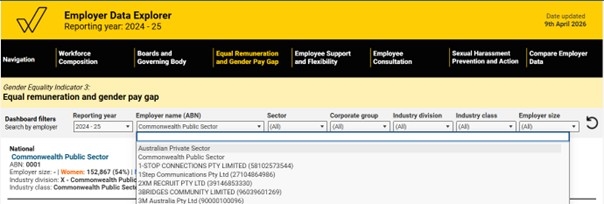
Details on the sector’s performance against each of the 6 Gender Equality Indicators can be found on the WGEA Employer Data Explorer. Click on the Employer name filter and select Commonwealth public sector to explore the results.