
Christine Castley reflects on her own multicultural journey and explores what it truly means to belong
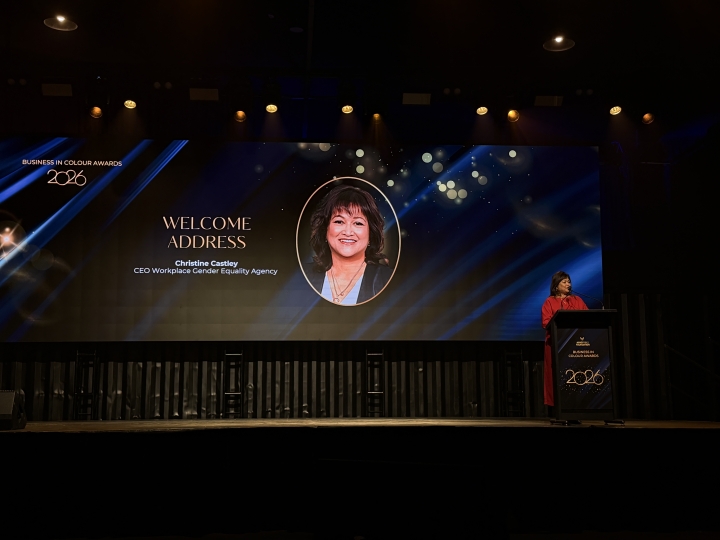
Good evening
I acknowledge the Bunurong people of the Kulin Nation and pay respects to Elders past and present. As I make this acknowledgement, I am reminded that the work we all do to create belonging carries responsibilities: to recognise the histories that came before us, listen to the voices that have too often been ignore or forgotten and think about the kind of future we are all creating together.
Thank you to MindTribes for inviting me to share this evening. I also acknowledge Assistant Minister Julian Hill, and the many people in this room whose work we celebrate tonight.
Tonight, I want to reflect on something I often think about: the curious art of belonging.
It is a curious thing, belonging. We feel it deep in ourselves, but it is something we cannot create entirely on our own. It is both personal and collective.
Perhaps this is where the art lies: remembering who you are, while learning to find your place in different worlds; reading the room, working out the unwritten rules, sensing when to blend in and when to stand out. Sometimes doing both at once.
I was born in Malaysia and came to Australia in the 1980s when I was a teenager. My heritage is mixed: Chinese, Indian, Portuguese, Spanish. So even before arriving here, I had grown up navigating different cultures to understand the world.
Growing up across cultures teaches you things not listed on your resume. The resilience of adapting to surroundings where the everyday is not the everyday, where the language you speak is not the language in your head, and a chameleon-like ability to inhabit a space, choosing when to blend in and when to stand out.
You develop a finely tuned radar for what is said or unsaid, or those unwritten rules that everyone seems to understand but nobody thinks to explain until someone breaks them.
Somewhere along the way, you create a blended culture uniquely your own. I have come to think of this as a secret superpower: a foot in different worlds, close enough to understand, but also enough distance to question assumptions others take for granted.
Australia has an extraordinary abundance of this asset.
Yet many of our workplaces still operate around remarkably narrow assumptions about what a successful employee or capable leader should look like.
Perhaps it is time we stopped asking quite so much of people to fit the mould, and started questioning the mould itself?
This question has followed me through my career, across government, as CEO of Multicultural Australia, as Chair of the Australian Multicultural Council and now as CEO of the Workplace Gender Equality Agency.
At Multicultural Australia, I met people with impressive qualifications and experience who, on arriving here, found that their skills had lost their currency. Doctors, engineers, business owners and community leaders struggling to have their capabilities recognised.
What stayed me was the waste of it all. The personal cost, yes, but also the opportunity lost to our country.
We often talk about the cost of making workplaces more inclusive, but I think we spend far too little time asking what it costs us not to change.
The skills we fail to recognise and the talent we lose because our workplaces and ways of working have not kept pace with the diversity of people’s lives, cultures and commitments.
This leads me to also reflect on a word we use constantly in Australian workplaces: merit.
I believe strongly in merit. But I also think we are less objective in recognising it than we like to imagine.
I have sat on many recruitment panels, and I have lost count of the times the discussion has ended with that familiar question: “Yes, but are they the right cultural fit?”
Consider what we are really asking. Whether someone shares an organisation’s values? Or whether they look, sound and think like the people already there?
Familiarity can feel like competence. Confidence can be mistaken for capability. Experience matters, but it also reflects the opportunities someone has already been given.
Merit and diversity are not competing principles. The real threat to merit is the bias that blinds us to the potential in people who don’t fit the mould.
My work at WGEA has given me another perspective on this.
Our national dataset covers 10,500 employers and nearly six million employees, helping us understand where barriers exist and giving employers evidence to inform action.
Data helps us move beyond assumptions. But data is only the beginning of the conversation.
Numbers can tell us what is happening, but they cannot always tell us why. The next step is not to introduce another policy, but to listen and to ask questions. This is even more important if we think about gender alongside race, culture, ability and identity.
The 2025 WGEA Scorecard shows women and men are now being promoted into their first management roles in equal proportions (50/50), yet women are leaving management in disproportionately higher rates.
Our latest research with the Bankwest Curtin Economics Centre helps explain why. This report, released last week, shows how women’s disproportionate share of unpaid care and domestic work continues to constrain their careers.
It also highlights what we call the ‘male pedestal effect’ which sees men elevated into leadership, even in female-dominated industries. We think of bias as something that holds people back. Sometimes it works by giving someone else a lift: recognising their leadership potential sooner, offering opportunity more readily or extending the benefit of the doubt a little further. These advantages accumulate.
The latest Chief Executive Women Senior Executive Census adds a troubling dimension. For the first time in a decade, women’s representation on ASX200 executive leadership teams has gone backwards. Only one in seven new CEO appointments in the last year went to women, down from one in four the previous year.
The picture is more troubling when we ask which women are reaching the top.
Women from cultural backgrounds other than Anglo-Celtic or North-West European are less than a quarter of women in ASX300 executive leadership. And First Nations women account for less than 0.7 per cent of women in these leadership streams.
WGEA does not collect data on the full intersectional picture, and I am committed to improving the evidence. But… better data must not become a precondition for action.
We don’t need perfect data to know that marginalisation exists. We already know enough to act. We need to stop fretting about how to measure marginalisation, and start acting to include and lift everyone.
These challenges feel particularly important now when racist and anti-multicultural rhetoric seems to be finding renewed confidence.
When confronted by racism, we are often quick to say “This is not who we are as a country.” It is a comforting response, but perhaps a more honest and challenging one is “This is not who we want to be.”
One reassures us about who we think we are. The other asks all of us to take responsibility for who we become.
Our diversity is not something Australia has to accommodate. It is part of what has made Australia.
And the Australia we want to be is not something we simply declare. It is something we have to keep standing up for.
This is why tonight matters. We are celebrating not just personal achievement, but leadership that changes the possibilities for others.
I have been fortunate to have opportunities I could never have imagined as a 15-year-old arriving in Brisbane from Kuala Lumpur. I know that I did not get here on my own. People saw potential in me, backed me and opened doors.
Those opportunities can change lives. But so can the assumptions we allow to go unchallenged or the unfairness we decide not to challenge
Cultures are shaped as much by what we allow to go unchallenged as by what we actively do. But our responsibility goes even further than calling out prejudice.
It also means learning how to bridge differences, navigate difficult conversations and bring people with us. I think of this as an important part of generous leadership: the ability to listen with curiosity, challenge without alienating, and hold firm to our principles while bringing others with us.
Perhaps this is where the curious art of belonging takes on its best meaning. We spend so much of our lives learning how to find our place in the world. But there comes a point when we have the opportunity, and the responsibility to shape the world in which others will find theirs.
This is what I see in the people we are celebrating tonight.
To all our finalists and award recipients: congratulations. Your achievements deserve recognition, but so too does the way you are helping others find their place, their voice and their opportunities.
Thank you