Public lecture by Christine Castley, WGEA CEO
Good evening.
I acknowledge the Gadigal people of the Eora Nation and pay my respects to Elders throughout all time.
As someone who migrated to Australia as a 15-year-old, I have always felt a deep sense of gratitude for the opportunities this country has given me. Over time, this sense of gratitude has deepened into something more; a profound respect for a country that is home to the world’s oldest continuous living culture.
Every generation, regardless of culture or place, inherits something.
We inherit stories and knowledge. We inherit ways of working and ways of living together. We inherit remarkable achievements and continuing challenges. And, perhaps most importantly, I believe that we inherit a responsibility to honour our past and strive to leave something better for those who follow us.
Thank you to the University of Sydney, for the privilege of delivering this lecture. In particular, I would like to acknowledge Professor Rae Cooper and the Australian Centre for Gender Equality and Inclusion, together with Professor Sargent, Dean of the Sydney Business School, for bringing us together this evening.
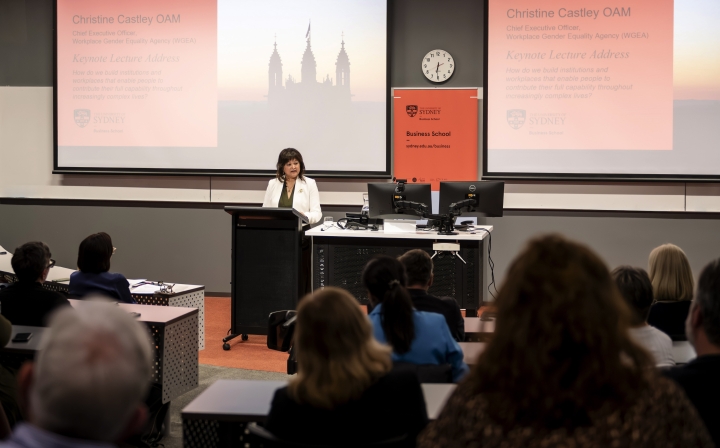
It is lovely to join you as the relatively new Chief Executive Officer of the Workplace Gender Equality Agency.
You will quite reasonably expect me to talk about workplace gender equality. And I will.
But I also want to suggest that workplace gender equality is a part of a much bigger Australian story: a story about participation, about capability, about opportunity and about the kind of country we want Australia to be. It is, ultimately, about how Australia works.
Over more decades than I care to count, of working in housing, criminal justice, multicultural affairs, social policy, domestic and family violence, crisis and disaster response, community services and government reform, I have come to believe that one of Australia’s most important questions is deceptively simple: Who gets to be part of the things that matter?
Who gets to build a good life? Who gets to contribute? Who gets to belong? Who gets to lead? Who gets to care? Who gets to benefit from Australia’s present and be a part of Australia’s future?
And perhaps an even more important question: Who gets left out?
Not always deliberately, sometimes unintentionally, sometimes because of assumptions no one has ever questioned.
And, sometimes, because we continue with our ways of doing things that once made sense but no longer reflect the lives people are living today.
Australia has always seen itself as a place where hard work and talent matters.
Where each generation hopes the next will have opportunities they never had.
It is a powerful national story.
It has never been equally true for every Australian (we could probably spend hours debating the mythology and meaning of the descriptor ‘working man’s paradise’), but the underlying national belief has always been that work provides dignity, opportunity and the path to a better life.
Perhaps another way of describing it is our social compact: the belief that if we contribute, play by the rules and work hard, we should have the opportunity to build a good life, and that our children should have even greater opportunities than we did.
This belief has always shaped what Australians, whether born here or newly arrived, believed was possible; for themselves, for their children and for our country.
Lately, however, it has felt like that story is becoming harder to sustain.
Recent surveys, including the Lowy Institute’s polling, suggest Australians are becoming less optimistic about the future than they have been in decades. Confidence that the next generation will enjoy a better life than their parents has declined. Cost of living pressures, housing affordability, technological disruption and global uncertainty all create a feeling that the future is becoming harder to navigate.
I don’t say this because I think Australia is losing its reason to hope. Quite the opposite.
I say it because moments like these should lead us to ask bigger questions. Not just about economic growth, but about participation, about opportunity and about how we convince Australians to have faith that they still have the chance to build a good life.
I believe work and workplaces have a bigger role in answering those questions than we often recognise.
At WGEA, our work is grounded in data and evidence. We like to talk about how data tells us what is happening. But we also like to talk about how stories help us understand why.
As I have immersed myself in WGEA’s extraordinary dataset, I have been struck by how the trends in the data parallel the stories of work colleagues and clients I have come across over the years. So let me share with you the stories of three Australians.
Story 1: Think of an Australian woman in her late forties.
She has a good job and a partner she loves. Together they have built successful careers while raising two children and paying off a mortgage they expected would be much smaller by now.
They worry about interest rates. They worry about ageing parents who are beginning to need more support. And they wonder whether they've saved enough for their own retirement.
At work she is respected. She has been encouraged to apply for a more senior role. She hasn’t ruled it out but she’s not sure how she will manage the extra hours and negotiating even more competing responsibilities. If she doesn’t apply, some would describe her decision as self-selection. She experiences it as trying to make all the pieces of her life fit together.
Story 2: Now think of a single father working as a casual security officer. His shifts change every week. Some start before dawn. Others finish well after midnight. He has a teenage daughter, still in school, who helps out with caring for her younger brother. But sometimes, if a child gets sick, there is no back-up and he must miss a shift, which means he doesn’t get paid. If a shift is cancelled, the household budget feels it immediately. He wants nothing more than to provide a secure life for his children. But every week feels like a difficult puzzle held together by determination and more than a little luck. Some might see a man choosing the flexibility of casual work. He experiences it as doing what it takes to have a job and be a good father.
Story 3: Or imagine a migrant couple cleaning offices after hours while trying to establish themselves in Australia. They work when most of the city is asleep. Their hours of work mean that they rarely, if ever, attend staff meetings. Their opportunities to build networks, practice English and establish a sense of belonging are limited. But they believe that if they work hard and make sacrifices, their children will have opportunities they never had. Some see low-skilled work or scarcely see them. They see the first chapter of an Australian story they hope their children will continue.
Three Australian stories, three different lives, three different sets of circumstances.
I suspect millions of Australians would recognise something of themselves in each of those stories.
Each wants to contribute. Each wants to belong. Each wants the opportunity to build a good life.
The question is whether the way we organise our workplaces is helping them or asking them to carry the burden of adapting alone.
Australia has always been at its best when we have expanded participation and opened doors for more Australians to contribute.
If you step back and look at our history, it is remarkable how often our progress has come from creating opportunity. Widening access to education. Increasing women's participation in paid work. Protecting equal pay for equal work. Recognising the contribution of people living with disability. Welcoming migrants.
In many ways, the Australian story has been one of steadily growing the social compact I spoke of earlier: that if we work hard, contribute, play by the rules, then we should have the opportunity to build a good life.
It remains one of the most powerful ideas holding us together.
The challenge today is not that Australia’s social compact has become less important. If anything, it has become more important.
Christine Castley, WGEA CEO
The real challenge, in my view, is whether our institutions, including our workplaces, have kept pace with the Australia they now serve. Because the Australia at work today is not the Australia many of our workplaces were originally designed for.
Over the past fifty years, who we are as a country has changed profoundly:
- We have come to better understand the richness of being home to the world’s oldest continuous living culture and we have become one of the world’s most culturally diverse nations.
Families and households take many different forms, and more people are caring for children and ageing parents at the same time. - Fewer people expect to stay in one job, one occupation or even one career for their entire working life.
- Our understanding of what it means to live a full and meaningful life has evolved.
But many of the assumptions embedded in our workplaces: about careers, leadership, flexibility, caring and what commitment looks like, were shaped for a different point in Australia’s history.
If our workplaces are to continue unlocking Australia’s capability, they too must evolve.
Which raises another question: How do institutions like workplaces evolve?
Because this is not the first time Australia has found itself at a moment when work, technology and society were changing faster than our assumptions about who does what in our community and in our economy.
In fact, if we look back through history, we find intriguing examples. Time and again, moments of profound disruption have expanded what we know about what people are capable of. Not because people suddenly became more capable. But because circumstances forced us to recognise capability that had always been there.
Take, for example, World War Two. When close to a million Australian men went off to fight, women stepped into factories, offices and roles previously closed to them. This rapid shift challenged social norms and expanded what women could do outside the home. They became engineers and mechanics. Scientists. Codebreakers. Cryptographers. Computer programmers. Factory floor supervisors.
They did not suddenly acquire intelligence, judgement or technical skill. The capability had always existed. What changed was whether society was prepared to recognise and allow it. Australia didn’t grow new capability; Australia discovered capability it had overlooked.
Then the war ended. And many, not all, but many, women were herded back into their homes, reminding us how fragile progress can be if it is not deeply rooted and sustained. Jobs returned to men. All too quickly, old assumptions about who belonged where in the workforce reasserted themselves.
We continue to live with the legacy of those assumptions. Australia still has one of the highest levels of occupational gender segregation in the OECD. Men and women concentrate in different occupations, limiting individual choice and leaving capability under-utilised across the economy.
History remembers the war. Often it forgets that one of its greatest legacies was that it revealed possibilities that were overlooked in ordinary times.
Another example: the recent extraordinary disruption that was COVID.
I don't want to romanticise that period. It brought enormous hardship. It separated families and devastated businesses. Many people worked in circumstances that were frightening, exhausting and uncertain.
But it also revealed something important about work. Those of us who have worked through times of disaster, crisis and disruption often observe that, for some reason, our ability to quickly mobilise our full capability is always easier in a crisis than in ordinary times.
Almost overnight, organisations accomplished changes that many had previously insisted were impossible:
- Flexible work.
- Distributed teams.
- Virtual collaboration.
- New ways of serving customers.
Ideas that had sat in strategic plans for years became reality within weeks. Not because technology suddenly accelerated, but because old assumptions gave way to necessity.
I am not suggesting everything we did during COVID should become permanent. I have led frontline agencies, so I know many jobs can only be done face to face. And I have led organisations of different sizes and character, so I also know that good hybrid work depends on getting the balance right between flexibility and in-person collaboration that helps organisations thrive.
But perhaps the most important lesson wasn’t where we worked. It was what we learned about the social norms around work.
Disruption cracked open old ways of thinking and showed us how quickly people and organisations can adapt. For a time, Australia at work looked very different; and many people discovered new ways to contribute.
Just as the war revealed capability we had previously overlooked, COVID revealed adaptability we had previously underestimated.
And yet only a few years later, we are beginning to forget what that period taught us. Just as before, social norms are pushing back against lasting transformation.
It is time to jolt our thinking.
Leaders need to view workplace gender equality not just as an HR issue, but as an organisational priority with real financial and productivity costs and implications.
If we take this perspective, progressing gender equality and flexible work becomes more than an ideal; it becomes an economic question about whether organisations are optimising the human capital available to them.
Every employer makes decisions about where to invest scarce resources. We invest in technology. We invest in equipment. We invest in innovation. But many organisations still see investment in flexibility and inclusion primarily as a cost, rather than as an investment in workforce capability.
The question shouldn’t be “Can we afford this?” but instead “What is the cost of not adapting?” That cost can be seen in unfilled vacancies, higher turnover, lost experience and lower productivity.
Yes, implementing changes involves trial, error and incremental shifts in much the same way that there is a learning curve with any new technology or process. But like any investment, the return from getting workplace gender equality right also compounds over time through stronger retention, a deeper talent pool and a more resilient workforce.
At a time of significant workforce shortages in priority skill areas, adaptation is not optional. Employers who fail to evolve will increasingly struggle to attract and retain talent. Over time, this becomes a competitive disadvantage.
If history teaches us anything, it is that capability has rarely been the problem. Time and again, our greatest advances have come when old assumptions were challenged, barriers were broken through and capability that had always been there was finally recognised. Today’s barriers are often less about immovable settings and more about culture, assumptions and systems designed for another era.
So what does all of this have to do with workplace gender equality?
I would argue everything.
Because thinking about workplace gender equality leads us to a much bigger question: Are our workplaces making full use of the capability that is already here, so that Australia itself works better?
This is where the role of WGEA becomes important.
Our role is often described as measuring workplace gender equality. This is true. But measurement is only the beginning. We measure progress so it can be tracked. We provide transparency so Australia can see where progress is real, where it has stalled and where more needs to be done. Together, they help Australia understand where capability is flourishing, where it is constrained and where employers can unlock far more of the talent available to them.
At WGEA, we have the privilege of being the custodians of a unique dataset. Every year, more than 10,000 employers report to us, representing over 5.4 million Australian employees. This workforce dataset gives us one of the clearest pictures of what is happening at work. What we see is encouraging; progress is real, but it is uneven.
You would have seen in our 2025 Gender Equality Scorecard that the national gender pay gap continues to narrow to 21.1%. More than half of employers reporting to WGEA reduced their pay gap last year. Men now account for 20% of primary carer’s leave, the highest on record.
Promotions into first management roles are now 50:50 between women and men.
Yet women leave management at higher rates.
This statistic fascinates me, because it tells us this is not just a pipeline problem. It tells us that getting people through the door is only part of the challenge. When thousands of capable women reach similar decisions about stepping back, not putting themselves forward or leaving organisations, we should ask questions not only about their choices but also about the signals our workplaces are sending.
Seeing people for who they are, at work and at home matters.
Recognising that someone who is at work could also be balancing care, living with disability, rebuilding after migration or working in regional Australia shifts the dial on whether their capability is recognised or constrained.
Christine Castley, WGEA CEO
Respect matters. Belonging matters. Psychological safety matters..
These are not abstract concepts. What might sound like soft issues are in fact hard drivers of organisational performance. They are experienced every day in meetings, on construction sites, in hospitals, in classrooms, on mine sites, on factory floors, in offices and on shop floors across Australia.
When capable people repeatedly make the same decisions, we need to resist the temptation to explain those decisions by individual preference alone. We need to be curious about the signals our workplace is sending. Small signals can accumulate:
- The meeting that is always scheduled before school drop-off
- The promotion that implicitly assumes long hours equal commitment.
- The joke that goes unchallenged.
- The idea that isn’t acknowledged until someone else repeats it.
None of these things, on their own, seems particularly significant. But together, they tell people who deserves to be here, who is trusted and who is likely to succeed.
There is another reason all of this matters. We often think of workplaces as separate from the rest of life. They are not.
Workplaces don’t simply respond to social norms; they create them. The decisions organisations make about flexibility, parental leave, career progression, caring responsibilities and what good leadership looks like shape far more than what happens between nine and five.
They influence who takes the children to school. Who stays home when a parent becomes frail. Whether a father feels able to ask for paid parental leave, flexibility or part time work without trepidation. Whether a mother feels she can pursue leadership without feeling she is letting her family down. They influence the choices families believe are available to them.
One of the common responses we hear from employers is that many of the recruitment and retention barriers they face lie beyond the workplace. They point to how employee behaviour is influenced by deeply ingrained social norms about who leads, who works and who cares. They are right. But those behaviours don’t just start in the home and end at the workplace door.
Because this is the reality: norms are simply patterns that are created and are kept alive by all of us. They can also be disrupted by all of us.
When workplaces expand opportunity, families gain choices. They gain greater financial security, greater resilience, more time together and more time to decide what works for them and not simply what the workplace allows.
This means that employers are doing far more than designing jobs. Whether they realise it or not, they are helping to shape the norms that ripple through families, communities and ultimately society itself.
That is an extraordinary responsibility.
And it is also an extraordinary opportunity.
Because every workplace that enables more people to contribute their capability helps strengthen not only its own organisation but Australia’s social fabric.
I began this evening by asking: who gets to be part of the things that matter?
I hope you will agree with me that the answer should not be determined by your gender, your culture, your caring responsibilities, or where you start in life.
And that the answer should depend on your opportunity to step into your fullest capability.
Every generation inherits something. We inherited workplaces built for a different Australia. Our opportunity is to build workplaces worthy of the Australia we have become.
Because this conversation is not only about women. Or men. Or even workplaces.
It is about something much bigger. It is about whether more Australians will get to be part of the things that matter. And whether the next generation will inherit opportunities greater than our own.
This is the future WGEA wants to help create.
I hope you will join us.