What the data reveals about women's careers, leadership and opportunity in mining.
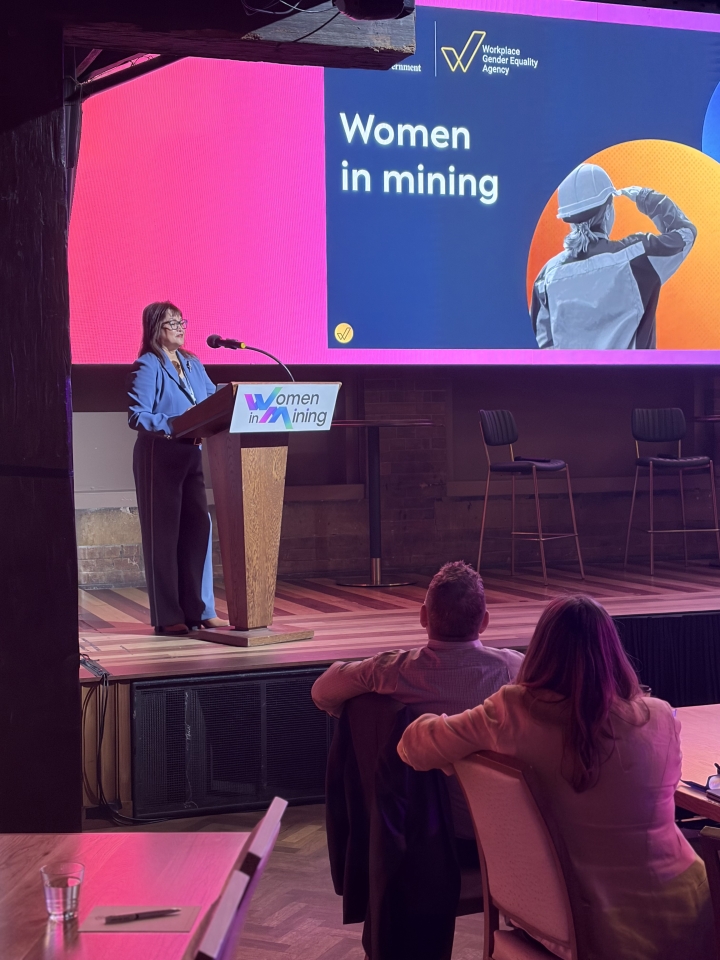
Good morning, everyone.
I acknowledge the Jagera and Turrbal people and pay my respects to Elders throughout all time. I also acknowledge First Nations people joining us today and the particular contribution of First Nations women working across Australia’s resources sector and communities.
Thank you for the opportunity to be here today.
I have been asked to talk today about what the gender pay gap data is telling us about mining and what the industry can do about it.
So let me deal with one thing right at the beginning – the gender pay gap is not the same thing as equal pay for equal work. If a woman and a man are doing the same job, or work of equal or comparable value, they must be paid equally. This has been the law since 1969.
The gender pay gap asks a different question: it looks across a whole workplace or industry and asks ‘is there a difference between what women and men are earning, on average or at the midpoint?’ A gap can exist even when every woman and man doing the same job is paid exactly the same. Why?
Because women and men may be concentrated at different levels of the organisation and into particular jobs. They may have different access to overtime, allowances and bonuses. One group may be more likely to work part-time. And one group may be much more heavily represented in the highest paid operational and leadership roles.
So when we see a gender pay gap where women are on average earning less (as they do in the mining sector), the interesting question is:
‘what is happening in this workforce that is producing this result?’
This is the question I want to explore with you today.
And Australia is unusually well-placed to explore the story behind this question.
For those of you who are not familiar with who we are or what we do, the Workplace Gender Equality Agency (WGEA) is our nation’s gender equality data collection Agency. Australian employers with 100 or more employees report information about their workforce and action on gender equality to us every year. We take that data and produce detailed insights about the gender pay gap and what is working well and what still needs more work.
The system of mandatory reporting to WGEA is now 12 years old. Our latest Gender Equality Scorecard covers more than 5 million employees across 19 industries. This gives us one of the richest datasets in the world on women and men at work:
- we can see who is being recruited
- we can see where women and men work
- we can see who works full-time and part-time
- and we can see who is moving into management, who takes paid parental leave and what people are paid on average.
We can see patterns not just across Australia or across an industry, but also within individual organisations.
This matters enormously. Because it allows us to move beyond assumptions and anecdotes and ask: what is really happening in Australia’s workplaces?
But I also want to acknowledge the limitations of the information we hold.
The numbers can tell us what is happening. But they can’t always tell us exactly why.
This is where the experience in this room matters. Many of you know what these numbers look like in real life:
- you know what it means to be the only woman on a crew
- you know whether the PPE fits
- whether the facilities are adequate
- whether a roster that looks reasonable on paper actually works with family commitments
- whether the person who takes parental leave is treated differently when they come back
- whether it feels safe to be on site and whether speaking up about behaviour feels safe.
There is a broader Australian workforce story sitting behind all of this. Australia’s workforce has changed profoundly in the last few decades and women now make up just over half of employees capture in the WGEA dataset. Women are highly educated and strongly represented across professional occupations.
But some other things have been much harder to shift:
- Australia still has a highly gender-segregated workforce
- women and men remain concentrated in different industries, different occupations and different levels of organisations.
This mattes when those patterns limit the pool of talent available to employers and contributes to skills shortages. It matters when the choices people make are shaped not just by preference, but by how the workplace is designed and who it suits best, and whether people can see a viable career for themselves there.
Women still undertake more unpaid care and they are much more likely to work part-time.
This matters because the way we divide care at home is closely connected to opportunity at work. When part time work and flexibility are overwhelmingly taken up by women, it affects the roles they access, the experience they accumulate and the pathways available to them, And it leaves men (who increasingly want to be involved in care at home) with fewer opportunities to do so.
Women also remain under-represented in many of our highest paid and most senior roles.
This matters because getting women through the door is not the same as giving them equal opportunity to progress. In most industries, we have made good progress on participation and recruitment – but the harder question is about who gets the opportunities, who progresses, who stays and ultimately who gets to lead.
So we have changed who is in the workplace much faster than we have changed many of the structures and assumptions that sit behind our work and how our workplaces are designed – who does particular jobs, who cares, who leads and what you need to do to have a successful career.
And in an industry competing for scarce skills, that matters.
Which brings me to mining.
Mining is one of Australia’s highest paying industries, and one where gender pay gaps are particularly persistent. WGEA’s analysis is that mining is one of the industries where 90% or more of employers have a gender pay gap favouring men.
Women are currently around 23% of the mining workforce. They hold about 38% of graduate roles and 33 percent of apprentice roles. But women also represent more than a third of employees in the lowest pay quartile. They are heavily represented in clerical and administrative roles, and community and personal service roles.
Importantly, these challenges are not experienced equally by all women.
Research has shown that Indigenous women often face overlapping barriers related to gender, race and organisational hierarchy. Many continue to be concentrated in lower-paid roles while also navigating unique workplace and community pressures.
By contrast, men dominate many of the higher paid occupations in the industry. Men hold the overwhelming majority of machinery operator and driver roles, technical and trade roles and about three quarters of CEO or equivalent senior leadership roles.
So, if you remember what I said at the beginning: the gender pay gap is not about whether a woman and a man doing the same job receive the same salary. It is the cumulative result for who does what work, who gets which opportunities, who progresses, who works part-time, who receives overtime and allowances and ultimately who gets the highest paid jobs.
We can think of the gender pay gap as an indicator on an operating dashboard. The number matters, but What the data tells us about mining is both encouraging and challenging. It shows progress. But it also shows there is still important work to do.
One of the most interesting findings in WGEA’s data is that more than 90% of mining employers have a formal policy or strategy on equal remuneration between women and men.
That is positive.
It demonstrates commitment.
But it also raises an important question.
If almost every organisation has an equal remuneration policy, why does the gender pay gap remain so high?
The answer is that policies matter, but policies alone do not change outcomes.
Sometimes the most powerful changes are the most practical.
One employer in the resources sector has delivered this by introducing on-site childcare to help employees balance work and caring.
The change has made life easier for working parents.
It has reduced stress, simplified daily routines and helped employees return to work with confidence after parental leave.
For the business, it has helped keep talented people in the workforce.
It is a simple example of how removing barriers can help people thrive, build their careers and feel more connected at work.
A policy cannot by itself overcome workforce structures, cultural norms or career barriers.
To understand that we also need to look beyond pay and examine the full employee lifecycle.
Let's start with recruitment. There is reason to be optimistic.
Women now represent more than a third of graduate recruits and apprentices entering the mining industry.
Importantly, these figures are significantly higher than women's overall representation in the sector. That tells us organisations are working hard to attract the next generation of talent. But attracting women into the industry is only part of the challenge.
The real test is whether those women stay. Whether they progress. Whether they move into operational, technical and leadership roles. And whether they can build long-term careers in the sector.
That brings us to the issue of retention.
Because when we look at organisations making the greatest progress, we find they are thinking beyond recruitment and focusing on 3 critical levers:
- safety.
- flexibility.
- and career progression.
The first lever is safety.
I know that I don’t have to explain to anyone in this room why safety matters in mining. But we need to think about safety broadly.
Safety is a workforce participation issue. If women do not feel safe, they will not stay.
When skilled people leave, businesses lose capability, experience and the investment they have already made in developing them.
Creating safe workplaces requires more than having a policy. WGEA’s data tells us that the overwhelming majority of mining employers have policies dealing with these issues.
The challenging question is: what happens at 2am on a site, inside a crew, when there isn’t an HR team standing beside you? Does the culture on-site reflect the policy? Does the supervisor reinforce the policy? Do colleagues? This is where leadership and accountability at every level of the organisation become real.
The second lever is flexibility.
This is where I think we need to broader the gender equality conversation beyond women.
Because one of the reasons inequality at work persists is inequality in how we organise life outside work. The answer cannot simply be to support and help women to become better at carrying both work and care. We need to make it genuinely possible for men to also care.
Mining has made important progress in this area.
More than 90 per cent of organisations have formal flexible work policies in place.
We are also seeing encouraging signs around the sharing of caring responsibilities.
In the latest WGEA data, men make up 53 per cent of employees taking primary carer parental leave in mining. This is significant.
When men feel able to take parental leave and participate fully in caring responsibilities, it starts to change assumptions. Caring stops being something that marks a woman out as different from the ideal worker.
And when flexibility becomes normal for everyone, it creates better outcomes for everyone.
This matters because the career consequences of flexibility are very real. In mining, 66 per cent of the people working part-tine are women. But only 3 per cent of managers in mining work part-time.
Put those two numbers together. Part-time work exists. But it barely exists in management roles.
So if part--time work is disproportionately how women accommodate caring responsibilities in the mining sector, and if management is overwhelmingly structured around full-time work, we should not be surprised to find that women find it harder to progress to management roles.
The question for employers isn’t whether every mining job can be made flexible. Clearly it cannot. You cannot operate a haul truck from your home.
But this is too often where the flexibility conversation stops. We need to spend more time asking:
What flexibility is actually possible in this job?
It may be roster design. Predictability of shifts. Job sharing. Compressed hours. Different approaches to FIFO and DIDO arrangements.
Good workplace design is not about saying yes to every request. It is about being rigorous about what the work actually requires, creative about how those requirements can be met and honest about the costs and trade-offs involved.
Which brings me to the third lever: career progression.
This is perhaps the most important one.
If leadership opportunities are predominantly designed around one way of working, are we unintentionally excluding talented people from progressing?
Because getting women through the door is not the same as giving them an equal opportunity to build a career.
If we consider again the earlier numbers: women are 38 per cent of graduate roles. 33 per cent of apprentice roles. BUT 23 per cent of the existing workforce.
These numbers don’t track the same women through time, so I am not claiming they prove attrition. But they tell us something important about the opportunity ahead of us - to convert this to a stronger entry pipeline and into long careers.
This means asking what happens after recruitment – who is seen as having potential? Who gets the stretch assignment? Who gets experience in the parts of the business that are considered essential for promotion?
International evidence suggests organisations with more gender-diverse management teams are more productive.
That means creating pathways to leadership is not only a gender equality issue.
It is a business performance issue.
Organisations have an opportunity to think differently about leadership pathways, development opportunities, job design, skill development and career progression.
The next phase of progress is about turning data into action.
This year, large employers selected Gender Equality Targets for the first time in their normal WGEA reporting with 3 years to meet them or demonstrate progress.
The results are still being collected, but, I can tell you today that early results indicate mining employers are selecting meaningful goals to improve gender equality in their workplaces.
The most common targets focus on increasing the representation of women in professional occupations, machinery operator and driver roles, apprenticeships and leadership positions.
Organisations are also committing to invest in employee consultation, including through exit interviews, employee experience surveys and representative networks to better understand employees' experiences.
That matters because numbers tell us what is happening. Employees tell us why.
The organisations that make the greatest progress will be those that listen carefully.
Those that respond thoughtfully. And those that continuously improve.
Let me finish with 3 calls to action.
Australia has a world-leading dataset on workplace gender equality.
Soon, CEOs and Boards will have access to this year’s WGEA Industry Benchmark Report.
And, in November, WGEA will release new results from the information that employers reported to us this year.
But there are steps you can action right now to play a part in positive change.
First, if you haven’t already, use the Data Explorer dashboard on the WGEA website to access data for employers and compare where they sit against industries and the whole nation.
Use it to understand your workforce.
Use it to challenge assumptions.
Use it to identify barriers.
And use it to drive meaningful change.
Second, invest in leadership capability.
Gender equality should not depend on whether an employee happens to have a supportive manager.
It needs to be embedded into systems, processes and leadership practice.
Every leader should understand their role in creating equitable outcomes and experiences.
And third, move beyond policy.
Many employers in the mining industry already have many of the right policies in place.
Policies on equal remuneration.
Policies on flexible work.
Policies addressing sexual harassment and workplace culture.
The next challenge is ensuring those policies translate into lived experience.
Because the goal is not simply to have policies.
The goal is workplaces where women enter, stay, progress and lead.
And when that happens, the benefits extend far beyond gender equality.
We strengthen workforce sustainability.
We improve talent retention. We expand access to skills. We support productivity.
And we position the Australian mining sector to meet the challenges and opportunities of the future.
The gender pay gap data is not simply telling us where we are; It is telling us where the opportunities are. The question now is whether we choose to act on that information.
Thank you.